

When the school year ends, many go-getter high schoolers are eager to take on a summer job for a little extra money and a change of pace. These are perfectly good motivations. Plus, many parents value this experience for the intangible benefits, like building a work ethic and learning personal responsibility.
But time is also a precious resource. If we’re only looking at financial return-on-investment, the summer job can also put a stark perspective on just how valuable prepping for college entrance exams can be.
Let’s do a little SAT-style math here.
For the sake of illustration, let’s say that you have 11 weeks of summer free from school. Let’s also suppose that you are working a low-skill, entry-level job that pays around $17/hour and that your employer is offering you 20 hours/week.
Within these parameters, over the whole summer, you’re looking at something in the neighborhood of $3,500-$4,000.
Your take-home will be even less, of course. Once the government has collected its share, it’s probably more like $3,100 to $3,600 that will actually end up in your bank account–maybe a little more, maybe less.
And this leaves aside other smaller costs, like gas or car insurance, that you and your parents might have to cover along the way.
Now let’s look at test prep, and we’ll use the SAT for this thought experiment.
If you’re thinking seriously about college, it turns out even a little preparation can go a very long way. Suppose you have University of Tennessee as one of your target schools. Here is what they require for merit scholarships:
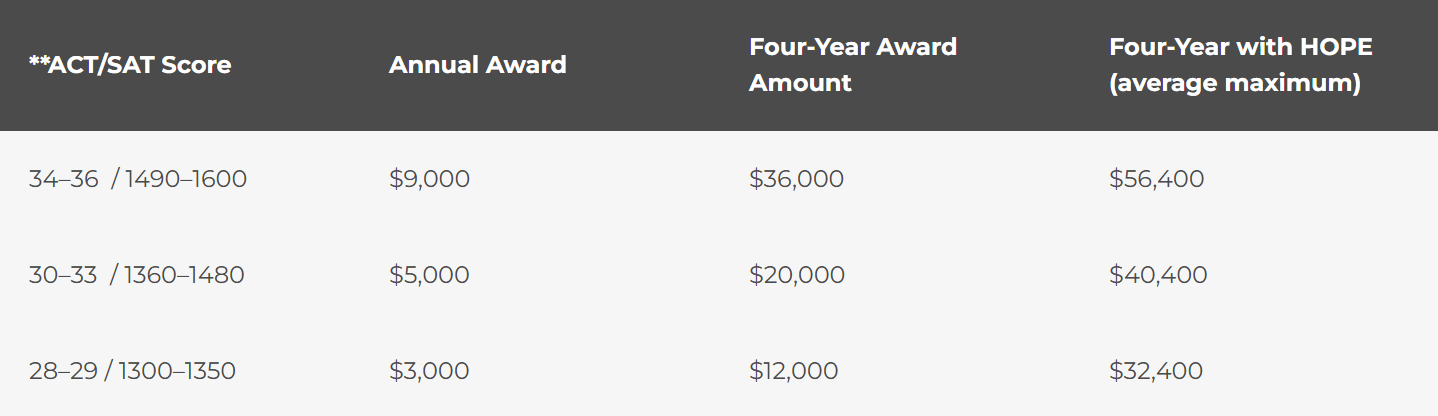
Imagine you get a decent SAT score on your first try with no real preparation, around 1100-1150 (67th-74th percentile). You would already be within striking distance of that lowest scholarship threshold.
Or maybe you scored an excellent 1300 but want to try for that next tier of scholarship before committing to the Volunteers.
What should you do?
Start by taking it at least one more time, which is one of the most tried and true methods of bumping your score by several percentiles. Most students score their best on their final try of multiple attempts. That’s time and money well spent, especially if you’re already close to a target score for the school you have in mind.
Now include any kind of test prep: taking a practice test, working through a study guide, or even receiving some tutoring. Averages suggest your score will be even higher. Historical data show that students who receive help in the form of SAT prep increased their scores by 56.2 points.
At Classic Test Prep, we strongly expect our deliberate methods and strategies to beat that baseline. Suppose you take our 6-8 week one-on-one tutoring option and that you moderately boost your score 100 points, from a very nice 1280 to a highly competitive 1380.
Now look again at Tennessee’s merit scholarship thresholds.
For many colleges, that 100-point boost will be the difference between admission and rejection. More tangibly, it could be tens of thousands of scholarship dollars over the course of a four-year degree.
We want families to be clear-eyed about the gravity of this situation because even many adults in the world of higher ed won’t. To put it bluntly, those numbers matter for what your life will look like after college, even though that day may seem a long way off.
Financial realities affect whether you have loans to repay and what size they will be. And that may in turn shape what kind of job you have to take or which graduate school you can attend after walking across the stage with your new bachelor’s diploma.
So then, if you think a few thousand dollars at the summer job is worth it, you should definitely think long and hard about preparing and practicing for the college exams.
Assuming you’re a diligent high schooler or a parent with foresight–and you probably are, since you’re reading this!–one summer partly devoted to test prep may go a very long way indeed.