

The Classic Learning Test is an increasingly important part of the testing landscape, but its impact can vary considerably depending on where a school is located.
Over the last few years, Florida in particular has invested significantly in the CLT. And as the state has expanded opportunities for students to use CLT scores, more and more districts have had to begin planning beyond the simple matter of offering the exam. Administrators now face practical questions about how to prepare students efficiently, how to fit instruction into an already crowded academic calendar, and how to ensure that as many students as possible reach the benchmarks that matter.
So, while the CLT is a new and growing opportunity, it also brings its own set of novel problems.
Outside Florida, most schools still view the CLT primarily as an admissions exam. A student interested in a particular college may choose to take it, while another student may prefer the SAT or ACT. Preparation therefore tends to happen at the individual level with an eye to the growing number of schools that accept the CLT. In turn, many school systems–even classical schools–still largely ignore the CLT because not enough of their students are leveraging it in their college applications.
But Florida’s educational environment is a very different situation.
Because CLT scores can be used for state concordance requirements and programs such as Bright Futures scholarships, schools increasingly have an institutional stake in student preparation for the CLT. This means educators might be trying to raise aggregate scores across a pool of thousands of test takers, depending on the district as Florida contains several of the largest school districts in the country: Miami-Dade, Palm Beach, and Hillsborough, to name just a few.
Administering the CLT at this scale raises some broader questions for educators:
Major strategic decisions hang in the balance.
Students and families should, of course, familiarize themselves with the current concordance requirements and scholarship thresholds. The important point for schools, however, is meeting benchmarks in aggregate and at scale.
So how does one do that?
Start by identifying some leverage points: some of these are peculiar to the CLT, others are basically shared across the major exams. Meaningful aggregate score gains come from targeting portions of the exam that are either under-taught in the traditional curriculum or governed by remarkably consistent rules. These areas often provide the greatest return on instructional time.
Let’s mark two respective examples to illustrate: logic problems and grammar questions.
Many students–if they’re fortunate–have spent years reading literature, writing essays, and analyzing historical documents. Mathematical curricula tend to skew toward other topics: algebra, geometry, etc. Relatively few, however, have received systematic instruction in formal logical reasoning, which is specifically tested on the CLT’s Quantitative Reasoning.
That might seem like a curricular oversight–and maybe it is–but it is also an opportunity. With some practice and pattern recognition in place, a pool of students can make some meaningful improvements quickly in this area.
Grammar opens a second window for efficient improvement.
Unlike literary interpretation, grammar questions in the Grammar/Writing section are rule-based. Few students will recall every grammatical principle they encountered in middle school, but the rules themselves remain stable, which means they are relatively easy to brush up on. Subject-verb agreement, pronoun reference, punctuation, parallel structure, modifiers, and sentence boundaries all greatly reward a little instruction and repeated practice. Effective preparation teaches them to identify objective errors using a relatively small number of principles.
Positive steps in these two question types don’t require overhauling the curriculum. Instead, they represent opportunities to produce healthy returns with relatively small instructional investment.
Still, implementing a well-rounded program to raise aggregate CLT scores can be a major obstacle for educators who are juggling hundreds of other balls. And that’s where we can help: Classic Test Prep knows that every school begins from a different place with certain goals and specific needs.
Some Florida districts already have teachers who are familiar with the CLT but want additional instructional resources. Others are introducing the exam for the very first time. Some schools will dedicate an entire semester to preparation, while others have only a weekly elective or a short intervention period.
Rather than forcing every school into the same program, we start with your institutional goals.
What benchmarks are you trying to reach? Graduation or scholarships? How are your students already performing? Which portions of the exam are creating the greatest obstacles? How much time can realistically be devoted to preparation?
From there, we develop schedules and instructional plans that fit naturally within the existing calendar. Whether preparation occurs in a dedicated course, an elective period, advisory blocks, or a single-day boot camp, our goal is to make implementation straightforward for administrators, teachers, and students alike.
Good instructional materials should reduce teachers’ workload rather than increase it.
Accordingly, we provide classroom-ready resources that instructors can begin using immediately. These include carefully sequenced exercises, targeted practice sets, and full-length practice exams that reflect the style and expectations of the CLT–some aspects of which can be more daunting than others.
We have also found that many (if not most) schools prefer physical instructional materials over more screen time and more EdTech.
While digital resources certainly have their place, we supply lots of hard-copy materials that teachers can pick up and run with on day one, without requiring every student to work from a device. This simplifies classroom management, makes annotation easier, and improves retention.
Here’s an example exercise sheet for the Logic problems noted above:
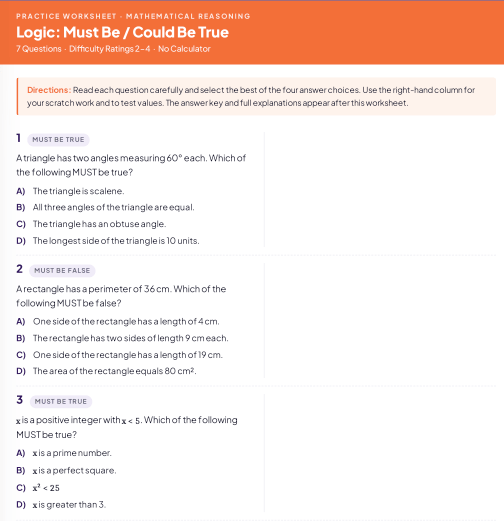
Because these materials are tailored to specific instructional objectives, teachers walk in with relevant exercises already in hand, which means they and their students don’t have to slog through a generic workbook from beginning to end or sort through the most useful excerpts.
Now, one concern administrators and other staff frequently raise is tech implementation.
Every new program competes for limited instructional time, technological resources, and administrative attention. A preparation program that requires an entirely new technological ecosystem often creates more work and more headaches.
While our materials can be delivered entirely hard copy, our digital resources are also designed to plug into the systems schools already use. Rather than asking districts to replace existing instructional technology, we know how to work within current IT infrastructure as necessary. This minimizes disruption while allowing teachers and administrators to focus on instruction instead of software implementation and security checks.
Because Florida’s education landscape has raised the stakes of the CLT for schools and districts alike, preparation can no longer be simply handing out practice questions and hoping for improvement.
It has to begin where good instruction always begins: with a clear-eyed assessment of where students stand, a definition of how the institution needs to help them, and a plan that closes the gap within the time actually available – whether that plan takes the shape of a semester-long course or a set of targeted interventions aimed at the score thresholds that matter most.
We expect that, in the coming years, what will distinguish schools that succeed is not so much the specific format they choose but the planning and discipline behind it: concentrating on high-impact content, building schedules teachers can sustain, and measuring progress against goals defined in advance rather than discovered painfully in retrospect.
Building that kind of preparation alongside schools is the partnership Classic Test Prep offers.