

The CLT’s Verbal Reasoning section is designed to reward close reading rather than speed-reading. Students have 40 minutes to answer 40 questions, with each question tied to one of four reading passages presented. Every passage contains exactly 10 questions, and because the structure of the readings is quite specific, you’ll know what kinds of texts they will encounter before they even begin.
The section opens with a work of literature, typically drawn from the classical or Western literary tradition. Students may encounter anything from an ancient epic or Greek tragedy to a nineteenth-century novel.
The second passage shifts to science, presenting an accessible piece of scientific writing accompanied by a chart, graph, or table. One question will always require students to interpret that visual rather than relying solely on the written passage.
The third selection comes from philosophy or religion, featuring authors who explore ethical, metaphysical, or theological questions.
Finally, the section concludes with a pair of historical or founding documents that present different perspectives on a common issue, requiring students to compare two related sets of arguments.
The underlying structure remains fairly consistent from passage to passage. Each group of ten questions follows essentially the same pattern, so knowing the pattern is a big advantage.
One recurring feature is the so-called evidence pair. The first question asks students to draw an inference from the passage, while the second immediately asks them to identify the specific lines that best support their previous answer.
Every passage also contains a vocabulary-in-context question. Here, success depends less on memorizing vocabulary lists than on understanding how context informs the meaning.
The remaining questions primarily test reading comprehension. Students will answer straightforward detailed–related questions whose answers can be located directly in the text, along with broader questions about the author’s central idea, purpose, organization, tone, or use of literary techniques. Here, the paired historical passages also add another layer by asking students to compare the authors’ viewpoints and consider how one writer might respond to the other’s argument.
Each passage concludes with two analogy questions. These often–but not exclusively–draw their terms directly from the passage students have just read. Rather than measuring vocabulary difficulty, they assess whether students recognize the relationship between ideas, concepts, or characters introduced in the text.
For those who haven’t seen it before, the joint passage pairing historical or founding documents can look particularly unusual. Here’s an example of one such pairing:
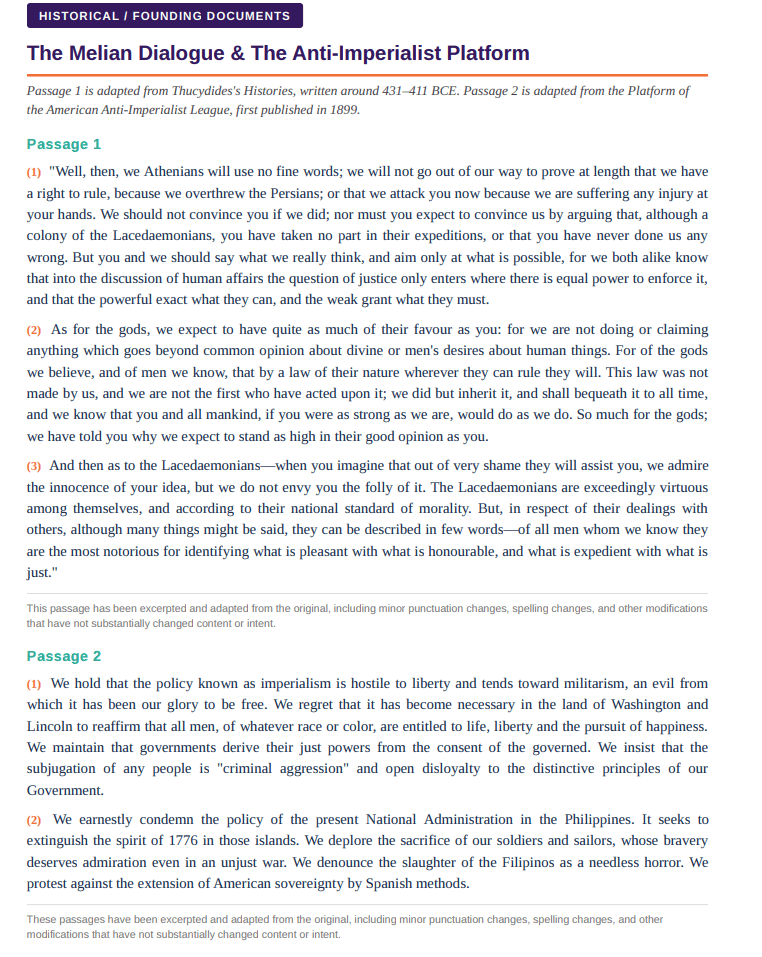
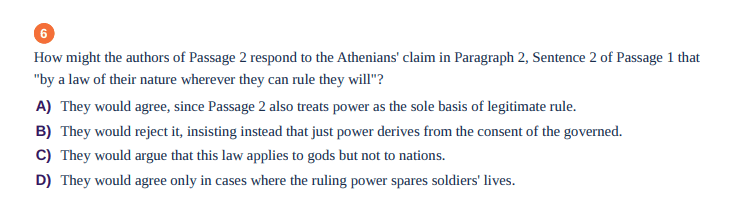
Many of the questions under the joint passage will actually be directed either to Passage 1 or Passage 2, but you will also encounter questions that ask you to think about both passages together.
For example,
Analogies are much less intimidating than they first appear–once you realize what you’re looking at. The words themselves are almost always familiar, but what matters most is recognizing the relationship between them.
A CLT analogy looks like Word A : Word B :: followed by four choices in the same format. The colon means “relates to,” and the double colon means “in the same way as.” The student’s only job is to name the relationship between A and B in a full sentence, then find the choice where the same sentence works with different words, in the same order.
Take a very simple example:
cat : mammal :: lizard : reptile
This analogy means, “cat relates to mammal in the same way as lizard relates to reptile.” This is a sound analogy because a cat is a kind of mammal just like a lizard is a kind of reptile.
But look at this one:
hawk : bird :: amphibian : frog
Even though this looks very similar to the first example, this is actually a bad analogy. Can you spot the problem?
Put it into words, “hawk relates to bird as amphibian relates to frog.” A hawk is a kind of bird, but an amphibian is not a kind of frog. Rather, a frog is a kind of amphibian.
This means that the order of the pair really matters a lot. In its own analogy questions, the CLT will offer you wrong answers that tempt you with just this kind of reversal.
Now, let’s look at some more complicated examples drawn from a CLT-style passage:
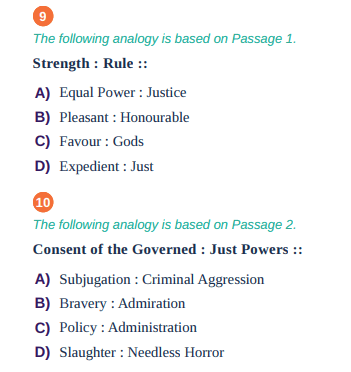
You have to start with the original pair. If the analogy is Strength : Rule, for example, think, “Strength relates to rule.” That sentence captures the relationship in its correct direction. From there, examine the answer choices, looking for a pair that fits the exact same sentence structure.
In the passage, strength qualifies a party to rule, just as equal power qualifies a party for the entry of justice into a dispute (Paragraph 1, Sentence 3). Both pairs share the same relationship. In the speakers’ description, strength is a prerequisite for rule in the same way that equal power is a prerequisite for justice.